

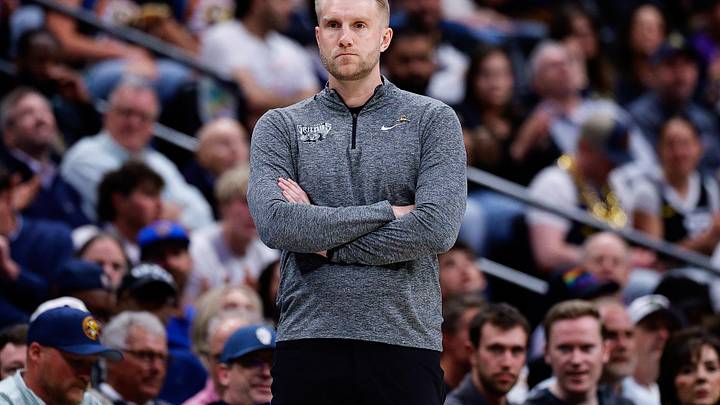
In his first full season as head coach of the Memphis Grizzlies, Tuomas Iisalo went through a whirlwind of ups and downs. He went into this year optimistic after getting a sniff of the playoffs last year and having, on paper, one of the most talented rosters in franchise history. The year quickly turned into one filled with injuries, a tumultuous relationship with his star player, and a blockbuster trade that put the team in full tank mode.
Despite the tank, Tuomas Iisalo had the Grizzlies playing a high-quality brand of basketball. Each night, no matter if the outcome would inevitably end in a loss, the Grizzlies played with high intensity and a synergy they couldn’t achieve consistently before the tank.
Iisalo ignited players like GG Jackson II and Ty Jerome to thrive in his system. His system even allowed players with fewer opportunities, like Olivier-Maxence Prosper and Rayan Rupert, to secure full-time, two-way deals. Iisalo showed promise as a coach when he had all five guys on the court, bought in, and played hard. He hopes to build on this next year. However, with the playoffs currently underway, there are three trends and keys to success that Iisalo can pick up going into next season.
1. Give stars more minutes
One of the most heavily criticized aspects of Iisalo’s coaching style was his rotations. Iisalo would have players on four to six-minute stints of action. Many argued that it didn’t allow players to get into rhythm and didn’t appropriately match the minutes of the opposing team's best players. It was reported that this was one of the points of dispute between Ja Morant and the coaching staff. Morant’s 28.5 minutes per game were a career low. The trend continued throughout the roster, as none of the projected starting lineup for the year (Morant, Jaylen Wells, Cedric Coward, Jaren Jackson Jr., and Zach Edey) averaged over 31 minutes. Jackson Jr. barely reached the 30-minute-per-game mark at 30.7 minutes per game.
If you look at the playoffs, the best players are simply playing the most minutes. Rotations are shortened to 8-9 players, and coaches are depending on their top players to make or break them. They aren’t depending on a formulaic flow of rotations that aren’t in tune with the ebbs and flows of the game.
Granted, you can’t keep this style through all 82 games. Eventually, players will experience what Iisalo’s current style in theory prevents: injuries and physical burnout. However, this year, as shown in the regular season, star players should be playing well over 30 minutes per game. Stars such as Shai Gilgeous-Alexander, Jaylen Brown, and Donovan Mitchell well eclipsed 30 minutes per game during the regular season and have easily upped their minutes north of 35 minutes during the playoffs.
You don’t want to run your players into the ground, but injuries are a part of the game. Letting your best players play the most minutes gives you the best chance to win every night. If Iisalo can give his top players more minutes night in and night out, improvements will be seen in the box score and overall record.
2. Can’t fall in love with the 3-point shot
It is understood that, since the 3-point boom of the mid-2010s, analytics indicate that teams should be shooting more 3s and fewer 2s. The Golden State Warriors set a precedent, and teams have been trying to copy it ever since. From these playoffs, a more balanced offensive attack is still the way to go.
This season, the Grizzlies truly lived by the “you live by the three, you die by the three" moniker. They ranked eighth in the league in 3-point attempts (39.5 per game), but 22nd in 3-point percentage (35.3%). Their frequency of attempts could have been more balanced as well. They ranked 21st in the league in two-point field goal frequency at 56.3% and 10th in three-point field goal frequency at 43.7%.
The Boston Celtics and Orlando Magic are examples of cold shooting from three coming back to bite teams. In Game 7 of their first-round series against the Philadelphia 76ers, Boston cut the 76ers' lead to one, trailing 97-96. During the last five minutes of the game, Boston missed 10 shots in a row, with seven of those attempts being three-pointers. Capping off an abysmal 13-for-49 shooting night from three.
In Game 6 of Orlando’s first-round series against the Detroit Pistons, Orlando hit a dry spell, missing 23 consecutive shots. Orlando led 70-54 when the run of missed shots started. Detroit led 89-75 when it ended, concluding in a 35-5 Pistons run. 13 of the 23 misses were from 3-point range. This ended a 9-for-36 night from three for the Magic.
Boston ended the playoffs shooting 33.7% from three, and Orlando ended slightly behind them at 32.8%. There’s a good chance that if both of these teams had a more balanced offensive attack, they could still be playing in the playoffs. However, both were eliminated in humiliating fashion because they fell in love with the three-point shot.
3. Improved half-court offense
A calling card of the playoffs is how the game slows down. Teams are better equipped to stop each other as they play each other so many times and have a better understanding of each other's game plans. Every great team has go-to plays, situations, or concepts to get them easy and efficient buckets in the half-court.
Iisalo’s system runs on the “speed kills” philosophy. Getting out in transition and getting shot attempts early in the shot clock is a staple of Iisalo’s offense. The Grizzlies ranked eighth in the league in pace with 101.69. They also ranked sixth in transition offense frequency, with them getting out in transition 23.8% of the time.
This play style can work well in certain situations. However, once the Grizzlies run into a team that is disciplined defensively and can get out in transition as well as, if not better than, the Grizzlies, they need to be able to execute their offense well in the half-court.
The Grizzlies struggled in this department this season. Points Per Possession measures overall scoring efficiency. The Grizzlies ranked 29th in the association in this category with 1.07. This led to their overall offensive rating of 112.4, ranked 23rd in the league. Granted, Zach Edey will be a big part of that solution next year with his presumed health. Edey brings a consistent, steady presence down low that impacts the team’s efficiency numbers on both ends of the floor.
Regardless, if Tuomas Iisalo expects to build a contender in this new era of Grizzlies basketball, he must figure out how to create efficient and consistent points in the half-court.
 Add us as a preferred source on Google